
Physiotherapy

Empty clinic reception desk with a closed laptop, a small plant and a chair

Booking Physiotherapy in London, Ontario at Our Downtown and South Clinics

Booking a physiotherapy visit in London, Ontario should feel straightforward. If our West clinic is not the most convenient option for you, Pro Function also has a Downtown clinic and a South London clinic. This guide explains how to book at either location, what to have ready, and how to choose the clinic that is

Booking Physiotherapy in London, Ontario at Our Downtown and South Clinics Read More »
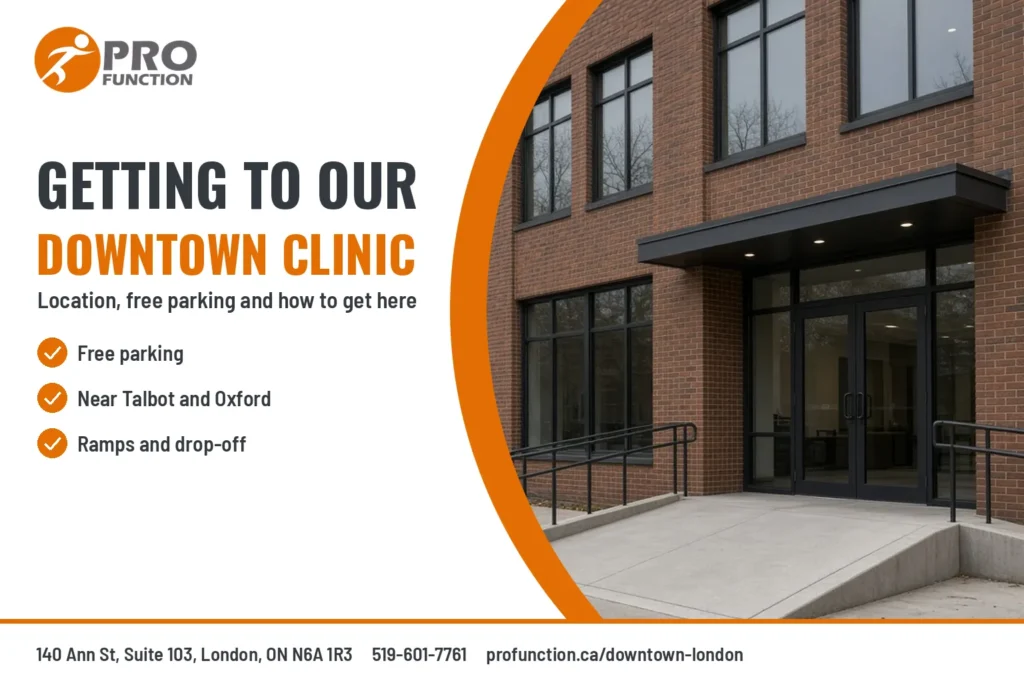
Street-level entrance of a brick mid-rise building with glass double doors and a concrete accessibility ramp with a handrail

Physiotherapy in Downtown London, Ontario: Location, Free Parking and Access

If you have a physiotherapy appointment coming up at our Downtown London, Ontario clinic, a little planning makes the day easier. This guide covers where Pro Function Health Care Team is, what to expect when you arrive, and how to reach us before your visit. It is practical information, so you can focus on getting

Physiotherapy in Downtown London, Ontario: Location, Free Parking and Access Read More »

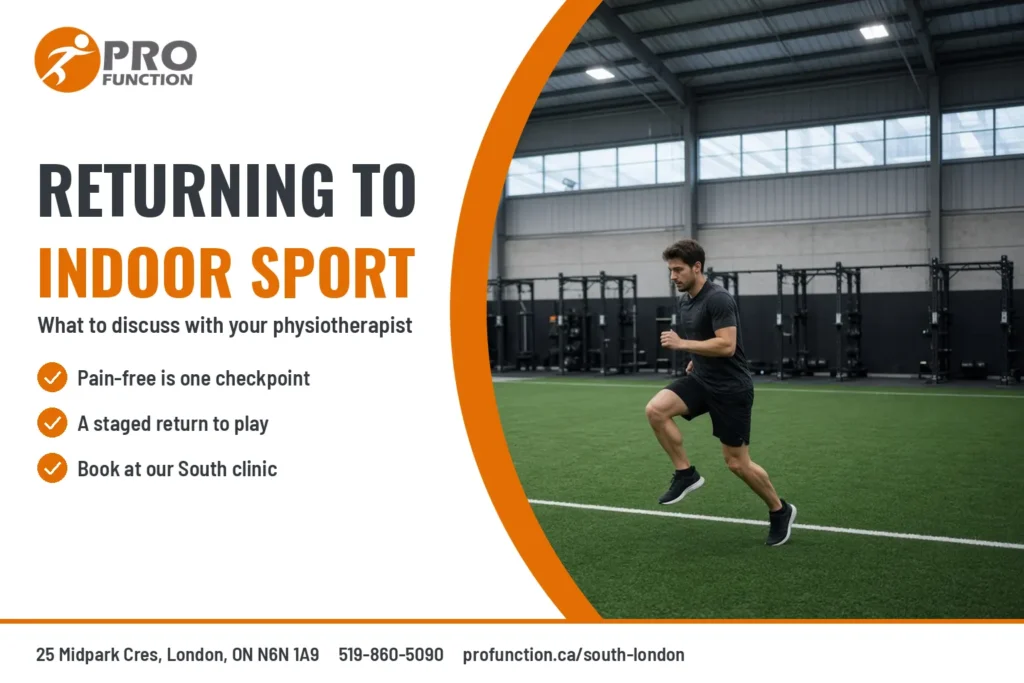
Athlete warming up on indoor turf in a large training facility

Returning to Indoor Sport After an Injury: What to Discuss With Your Physiotherapist

Feeling better is not the same as being ready for full indoor training. Court sports, turf sports, climbing, martial arts and gym classes all ask for speed, change of direction, landing control and endurance. A return plan should match those demands. This article lists practical questions to bring to physiotherapy. It is education, not clearance

Returning to Indoor Sport After an Injury: What to Discuss With Your Physiotherapist Read More »

Quiet clinic waiting nook with an armchair, side table and frosted glass door

Your First Pelvic Health Physiotherapy Visit: Questions, Consent and What to Expect

Booking a first pelvic health physiotherapy visit can feel unfamiliar. Many people want to know what will be asked, what an assessment involves, and how consent works. This article outlines common parts of a first visit so you can prepare questions. It is general education. Your own visit may look different based on your goals

Your First Pelvic Health Physiotherapy Visit: Questions, Consent and What to Expect Read More »

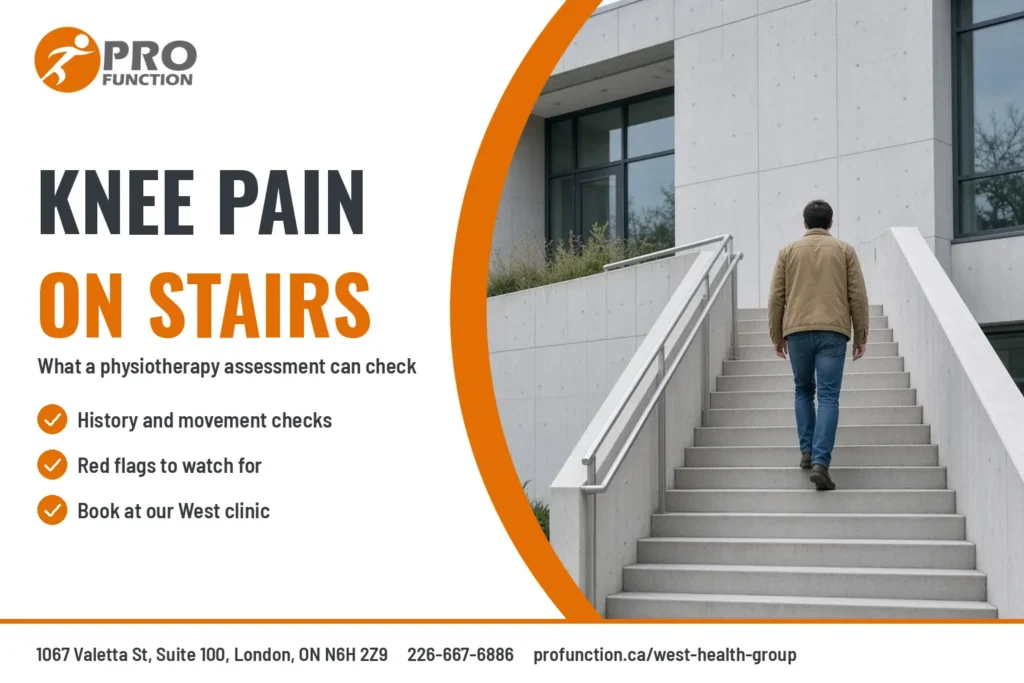
Person walking up an outdoor concrete staircase toward a modern building entrance

Knee Pain on Stairs or When Getting Up: What a Physiotherapy Assessment Can Check

Knee pain that appears when you climb stairs, go down steps, or stand up from a chair is a common reason people look for physiotherapy. Those moments load the joint in a specific way. A physiotherapy assessment is designed to understand how you move, what irritates symptoms, and which factors are safe to work on.

Knee Pain on Stairs or When Getting Up: What a Physiotherapy Assessment Can Check Read More »

Walking shoes and brown loafers sitting on a light wood bench in a bright clinic waiting area

Getting Used to Custom Orthotics: Shoes, Follow-up and When to Call Your Pedorthist

New custom orthotics often feel different at first. That does not always mean something is wrong. It usually means your feet and lower legs are adapting to a new support surface. This article is about the follow-up stage after fitting: how to wear them in, how shoes matter, what questions to ask, and when to

Getting Used to Custom Orthotics: Shoes, Follow-up and When to Call Your Pedorthist Read More »

Physiotherapy for Vertigo

Physiotherapy for Vertigo: How Vestibular Rehabilitation Can Help

Feeling as though the room is spinning, losing your balance when walking, or becoming dizzy when you turn your head can be unsettling. Vertigo can interfere with everyday activities such as getting out of bed, driving, exercising, working, or simply walking around your home. While vertigo has many possible causes, physiotherapy for vertigo can be

Physiotherapy for Vertigo: How Vestibular Rehabilitation Can Help Read More »

Brooke Edwardson

MClSc (AHCP-SEM), MPT, BScPT, Sport Cert.  

Physiotherapist London Ontario
Orthopaedic Physiotherapy
Sports Injuries Physiotherapy
Post Surgical Rehab
Sports Team On-Field Medicine

Choose Brooke for:
• Soccer, Volleyball, Basketball and Running Injuries
• Industrial / Physically Demanding Jobs + Injuries
• Spinal, Hip and Knee Injuries
• Pre- and Post- Surgical Cases (eg. ACL Recovery after Surgery)
• Strength and Conditioning
• Sports Team Medical Coverage; Tournaments, Travel, Seasonal

Brooke Edwardson

MClSc (AHCP-SEM), MPT, BScPT, Sport Cert.  

Physiotherapist London Ontario
Orthopaedic Physiotherapy
Sports Injuries Physiotherapy
Post Surgical Rehab
Sports Team On-Field Medicine

Choose Brooke for:
• Soccer, Volleyball, Basketball and Running Injuries
• Industrial / Physically Demanding Jobs + Injuries
• Spinal, Hip and Knee Injuries
• Pre- and Post- Surgical Cases (eg. ACL Recovery after Surgery)
• Strength and Conditioning
• Sports Team Medical Coverage; Tournaments, Travel, Seasonal

If you’re an athlete, at any level, you’ll want to meet Brooke.  Brooke Edwardson’s resume and skillset with athletes is extensive, and recently she added to her resume with a Masters in Advanced Health Care Practice in Sports and Exercise Medicine (AHCP-SEM) from Western University.   While in the program,  Brooke focused on all aspects of delivering comprehensive sports medical coverage for a wide variety of venues.  Additionally, she completed research on ACL-related injuries based on playing surface types in collaboration with several sports medicine and surgical physicians.  Brooke says the experience gave her one-of-a-kind insight into the risks, prevention strategies, and  keys to post-ACL surgical rehabilitation at the highest of levels. 

Having originally graduated with a Masters of Physiotherapy from Western, Brooke has quickly developed into one fo London’s brightest and most dynamic sports physiotherapists. Brooke sees patients both on and off the field and when in clinic, she chooses to treat at Pro Function’s sports injury clinic due to the fact that the facility has 40,000 sq ft of turf and two weight-training areas which allows her to really challenge her patients as they return to activity/sport. 

Professionally, Brooke has worked in various formats with Skate Canada, the Toronto Rock, at both the Canada Games and the Ontario Summer Games, with the Toronto Triathlon, St George Rugby, Great Lake Canadians (GLC) Baseball, and right here in London as the lead physiotherapist with FC London. Additionally, Brooke works as a consultant for GM Canada and feels the physicality and endurance required with line-side work mimics many of the soft tissue injuries commonly associated with the training errors seen in athletes. 

Outside of the clinic, Brooke loves finding creative ways to stay active and is up for the challenge of trying out a new sport or skill.  She enjoys running, rock climbing, hiking, water sports, and of course soccer!  She also loves to travel and spend time with family and friends.