
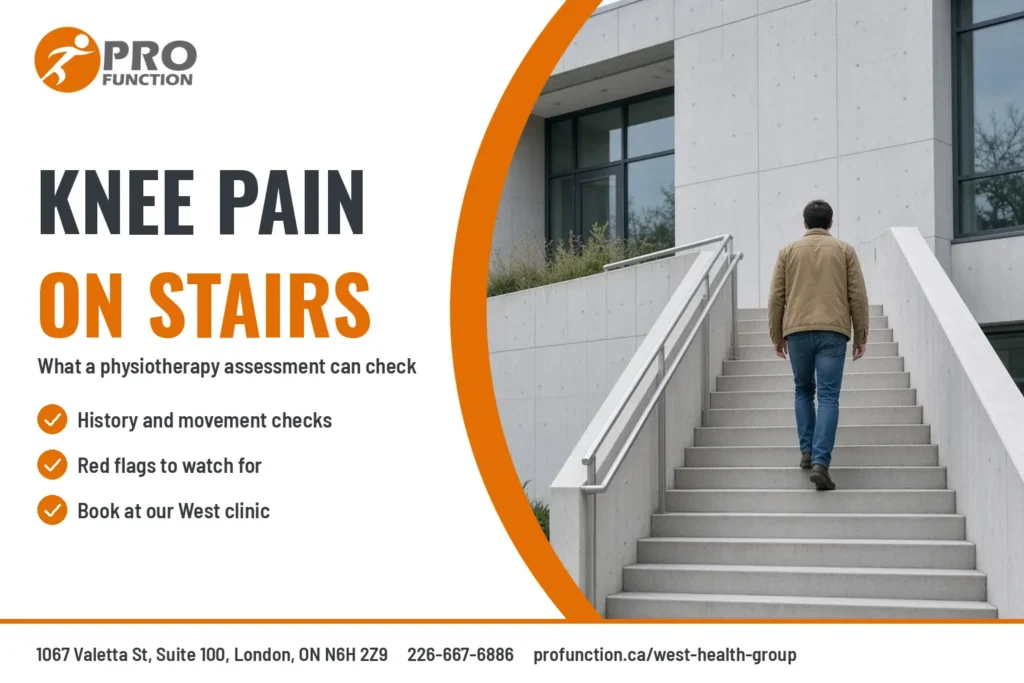
Knee pain that appears when you climb stairs, go down steps, or stand up from a chair is a common reason people look for physiotherapy. Those moments load the joint in a specific way. A physiotherapy assessment is designed to understand how you move, what irritates symptoms, and which factors are safe to work on. This article explains the kinds of questions and checks that often come up. It is general education. It cannot diagnose your knee from a webpage.
For appointments in West London near Hyde Park, Oakridge, Byron and Westmount, see physiotherapy at our West London clinic. You can also read more about a physiotherapy assessment on our service page.
Why stairs and sit-to-stand stress the knee
Going up stairs asks the thighs and hips to lift body weight. Going down stairs asks the knee to control lowering under load. Standing from a chair combines both strength and timing. If strength, mobility, balance or movement habits are off, people often notice symptoms in those tasks first, even when walking on flat ground still feels manageable.
Canadian clinical writing on knee osteoarthritis care highlights education and exercise as core parts of physiotherapy management, along with advice on activity and self-management (British Columbia Medical Journal, Physiotherapy and knee osteoarthritis). Not every stair-related knee problem is osteoarthritis, which is one reason an individual assessment matters.
What to expect in a physiotherapy assessment
A typical first visit focuses on history and movement, not a one-size exercise sheet. Your physiotherapist may ask about:
- When symptoms started and what makes them better or worse
- Stairs, squatting, kneeling, running, kneeling at work, or prolonged sitting
- Swelling, locking, giving way, night pain, or recent injury
- Past knee, hip, foot or back problems
- Footwear, work demands and sport goals
They may watch how you walk, step up and down, sit to stand, and move the hip and ankle as well as the knee. Strength, range of motion and balance are common checks. Imaging is not always required on day one; your clinician will explain if a medical follow-up seems appropriate.
Red flags: when to seek urgent medical care
A physiotherapy clinic is not an emergency department. Seek urgent medical care, or ask your physician for prompt advice, if you have sudden severe swelling after trauma, an inability to bear weight, obvious deformity, fever with a hot swollen joint, calf pain and swelling that worries you for a clot, or progressive neurological symptoms. Your physiotherapist can also help you decide when to loop in your family doctor. This list is not complete; trust your judgment if something feels acutely wrong.
What assessment is (and is not)
Assessment can identify movement patterns and load tolerances to guide a plan. It cannot promise a cure from reading symptoms online. It also should not hand you a long home program before anyone has watched you move. Canadian guidance for knee osteoarthritis care stresses tailored education and exercise rather than passive care alone (BCMJ). Your plan should match your goals, whether that is grocery stairs, work shifts, or returning to sport.
How treatment plans often start
After assessment, many people begin with education about which activities to modify for a short time, and which movements are still safe. Strength work for the hip and thigh, mobility work where stiffness limits stairs, and gradual return to the tasks that bother you are common themes. Adjunct options such as manual therapy or taping are sometimes used alongside exercise when your clinician thinks they help you move better. None of these replace progressive loading when that is appropriate for you.
At our West clinic, physiotherapy is the core service for this type of problem. Depending on your presentation, the team may also discuss chiropractic care, massage therapy, acupuncture or pedorthic input. Those options are only used when they fit the assessment findings.
Preparing for your visit
Bring:
- Supportive shoes you use on stairs and at work
- A short list of aggravating and easing activities
- Any recent imaging reports you already have (if available)
- Questions about work, driving, sport or travel
Wear clothing that lets the clinician see your knees and hips move.
Everyday examples to describe at your visit
Concrete examples help more than vague pain scores alone:
- “Pain starts on the third flight at work.”
- “Getting out of the car after an hour is worse than walking.”
- “Going down stairs is harder than going up.”
- “It is fine in the morning and louder after supper dishes.”
Those details guide which tasks your physiotherapist will watch and which early modifications make sense.
Booking at West London
For local appointments, contact physiotherapy at our West London clinic. You can book at our West clinic online or call 226-667-6886. Learn more about our physiotherapy assessment approach on the service page.
Short FAQ
Is stair pain always arthritis? No. Many structures and movement patterns can irritate the knee during stairs or sit-to-stand. Assessment is how clinicians narrow the likely contributors.
Do I need an X-ray before physiotherapy? Not always. Your physiotherapist and physician can advise based on your history. Imaging is a tool, not an automatic first step for every knee complaint.
Will I get exercises on the first visit? Often you leave with a small number of clear next steps. The exact dose depends on what the assessment finds and what you can do comfortably at home.
Educational content only. It does not replace an assessment or medical care. Outcomes vary.